

Digital printing is transforming the decorative paper industry.
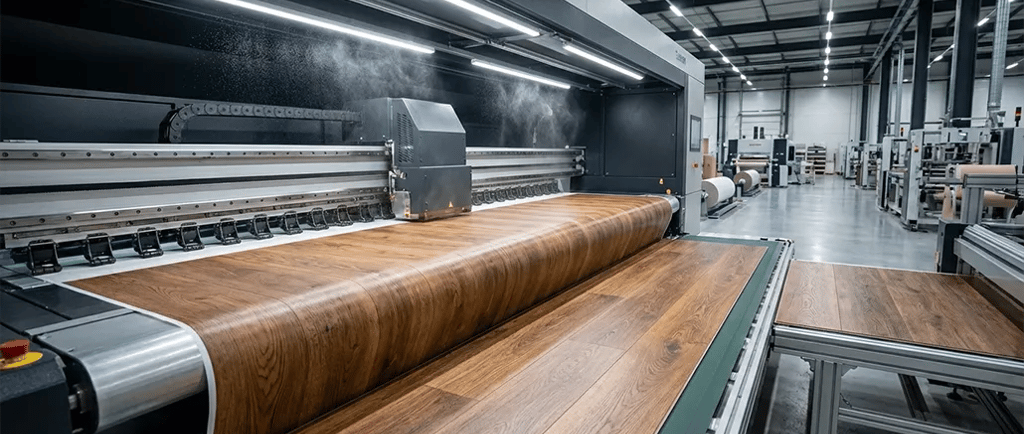
Digital printing is transforming the furniture surface industry by enabling short production runs, rapid prototyping and faster product launches. This technology allows designs to move from concept to production much faster, giving manufacturers greater flexibility in a market driven by fast-changing trends and customised demand.
Digital Printing Revolution in Decorative Paper: How Short-Run Production Is Transforming the Furniture Industry
Why Digital Printing Is Redefining Decorative Surfaces, Customisation and Industrial Efficiency in Furniture Manufacturing
Introduction: A structural transformation in decorative surfaces
The decorative surfaces industry is entering a profound transformation. For decades, furniture manufacturers relied on large-scale analogue printing processes—particularly gravure printing—to produce decorative papers used in laminates, melamines and other furniture applications. This model dominated because it was efficient at scale. Long production runs, predictable demand and stable collections justified the investment in cylinders, setup time and large minimum quantities.
However, the market environment in 2026 looks very different.
Furniture brands now operate in a landscape defined by:
Rapid trend cycles
Fragmented consumer preferences
Increasing demand for customisation
Shorter product lifecycles
Pressure for faster market launches
In this context, traditional production systems are becoming increasingly rigid. The industrial model built around long production runs is struggling to adapt to the volatility of contemporary design markets.
This is where digital printing is fundamentally changing the rules.
Digital printing technologies are rapidly gaining ground in decorative surfaces, particularly in the production of decorative papers for furniture. Their value is not limited to printing itself; rather, they enable a completely new manufacturing logic based on flexibility, speed and responsiveness.
For companies working in surface design, including decorative paper developers and furniture manufacturers, the shift towards digital printing represents one of the most important industrial changes in the sector in the last two decades.
The traditional decorative paper model: scale over flexibility
To understand the impact of digital printing, it is necessary to first examine the traditional model that has defined decorative paper production for decades.
Gravure printing has been the dominant technology because it excels at producing very large volumes with consistent quality. Once cylinders are produced and machines are set up, the cost per metre becomes extremely competitive.
However, this system also presents structural constraints:
High initial setup costs
Long preparation times
Large minimum production runs
Limited design variation within a run
These limitations were acceptable in an environment where furniture collections remained stable for years. Manufacturers could commit to large production volumes because demand was predictable.
Today, that predictability has disappeared.
Furniture brands are under increasing pressure to refresh collections frequently, respond to micro-trends and introduce new finishes faster than competitors. This has exposed the rigidity of the traditional production system.
Digital printing emerges precisely at this point of tension.
The rise of digital printing in decorative surfaces
Digital printing technologies have evolved dramatically over the last decade. Improvements in print heads, ink chemistry, colour management and machine reliability have transformed digital printing from a niche prototyping tool into a viable industrial solution.
In decorative paper production, digital printing now enables manufacturers to produce high-quality wood grains, stones and textile textures with exceptional precision.
But the real disruption lies not only in image quality—it lies in operational flexibility.
Digital printing removes several structural barriers inherent in traditional printing processes. It eliminates cylinders, reduces setup time and allows immediate design changes without interrupting production.
As a result, digital printing supports an entirely new production model built around short runs, rapid iteration and market responsiveness.
Short-run production: the new industrial logic
One of the most significant advantages of digital printing is the ability to produce short production runs efficiently.
In the traditional system, producing small volumes is economically inefficient because setup costs remain high regardless of the final quantity. Digital printing, by contrast, allows production to begin almost immediately, without expensive tooling.
This opens the door to short-run manufacturing strategies.
Short-run production offers several advantages:
First, it reduces inventory risk. Manufacturers no longer need to produce large quantities of decorative paper in advance. Instead, they can produce smaller batches aligned with real market demand.
Second, it enables faster product launches. New designs can be introduced quickly without committing to large initial production volumes.
Third, it allows companies to experiment with new aesthetics, colours or textures without significant financial risk.
This flexibility is particularly valuable in a market where trends evolve rapidly.
The shift towards short-run production is therefore not merely a technological change. It represents a new industrial mindset centred on adaptability and speed.
Personalisation: responding to fragmented demand
Consumer expectations in the furniture sector have evolved significantly. Buyers increasingly expect products that reflect individual taste, lifestyle and identity.
This demand for personalisation is difficult to address within traditional production systems.
Digital printing enables a completely different approach.
Because designs are stored as digital files rather than engraved cylinders, variations can be introduced easily. This allows manufacturers to create multiple design versions within the same production environment.
Examples of personalisation enabled by digital printing include:
Colour variations of the same wood grain
Custom pattern scales
Region-specific collections
Limited edition finishes
For furniture brands, this capability provides an opportunity to differentiate products in highly competitive markets.
Rather than offering a single standard finish, brands can create a broader palette of surfaces tailored to different customer segments.
Digital printing therefore aligns perfectly with the increasing fragmentation of global design preferences.
Rapid prototyping: accelerating design development
Another transformative advantage of digital printing is rapid prototyping.
In traditional decorative paper development, creating a prototype can take weeks or even months. Designers must prepare artwork, engrave cylinders and run test prints before evaluating the result.
This process significantly slows innovation.
Digital printing eliminates most of these steps.
Designers can print prototypes directly from digital files, allowing immediate evaluation of colour, scale, texture and composition. If adjustments are required, they can be implemented instantly and printed again.
This dramatically accelerates the design cycle.
Instead of waiting weeks for physical samples, teams can iterate designs within days or even hours.
Rapid prototyping also facilitates better collaboration between designers, manufacturers and clients. Physical samples can be produced quickly for presentations, enabling faster decision-making and reducing uncertainty in product development.
Faster time-to-market: a decisive competitive advantage
Speed has become one of the most critical factors in the furniture industry.
Brands must constantly introduce new products to maintain relevance in retail environments and digital marketplaces. Delays in development or production can result in missed market opportunities.
Digital printing significantly reduces time-to-market.
Because designs can move directly from digital creation to production without complex setup procedures, the time between concept and launch is dramatically shortened.
This has several implications for furniture manufacturers:
Faster response to design trends
More frequent collection updates
Reduced risk of obsolete inventory
Greater competitiveness in global markets
In a sector where trends evolve rapidly, the ability to launch products faster than competitors can determine market leadership.
Integration with digital design ecosystems
The growth of digital printing is closely linked to broader digital transformation across the design and manufacturing sectors.
Modern furniture development increasingly relies on digital workflows:
3D modelling
digital material libraries
real-time rendering
parametric design systems
Digital printing integrates seamlessly with these workflows.
Design files can move directly from design software to printing systems without intermediate translation steps. This enables greater accuracy between the original concept and the final printed surface.
Furthermore, digital design libraries allow companies to store extensive collections of decorative surfaces that can be adapted, modified or reproduced at any time.
This integration strengthens the connection between creative development and industrial production.
Sustainability benefits of digital printing
Sustainability has become a critical priority across the furniture industry. Manufacturers are under increasing pressure to reduce waste, energy consumption and environmental impact.
Digital printing contributes to sustainability in several ways.
First, it reduces material waste. Traditional printing often requires long setup runs before achieving optimal quality, generating significant waste. Digital printing minimises these setup losses.
Second, it allows production aligned with actual demand. Short-run manufacturing reduces overproduction and excess inventory.
Third, many digital printing systems use water-based or environmentally improved inks compared to traditional solvent-based processes.
While digital printing is not inherently carbon-neutral, its operational efficiency can contribute to more responsible production practices.
Industrial challenges and limitations
Despite its advantages, digital printing is not without challenges.
Traditional gravure printing remains more cost-efficient for very large production volumes. When demand for a particular design is extremely high, analogue printing may still offer lower unit costs.
Digital printing equipment also requires significant investment, particularly for high-resolution industrial machines capable of producing furniture-grade decorative papers.
Furthermore, colour consistency and texture synchronisation remain technical challenges that manufacturers continue to refine.
For many companies, the future will not involve replacing traditional printing entirely, but rather integrating both technologies within a hybrid production system.
In this hybrid model:
Digital printing serves short runs, prototypes and custom designs
Gravure printing serves high-volume production
Together, they create a more flexible and resilient manufacturing ecosystem.
Strategic implications for the decorative surfaces industry
The expansion of digital printing has significant implications for companies operating in decorative surfaces.
First, design becomes more strategic. Because design variations can be produced more easily, companies must invest more heavily in developing distinctive and compelling surface collections.
Second, speed becomes a competitive advantage. Firms capable of translating trends into printable designs quickly will outperform slower competitors.
Third, collaboration between designers and manufacturers becomes more integrated. Digital workflows require closer alignment between creative and industrial teams.
For surface design specialists, this transformation represents an opportunity to position themselves as strategic partners rather than simple suppliers.
The role of surface design studios in the digital era
As production technologies evolve, the role of surface design studios is also changing.
In the past, many design studios focused primarily on aesthetic development. Today, successful studios must combine creativity with technical understanding of printing technologies and manufacturing constraints.
Designers must understand:
repeat structures
colour management
texture synchronisation
compatibility with printing systems
This interdisciplinary expertise allows design studios to develop surfaces that are both visually compelling and industrially viable.
Companies capable of bridging design and production will become increasingly valuable in the digital printing ecosystem.
Conclusion: digital printing as a catalyst for industry transformation
Digital printing is not merely a new manufacturing technology. It represents a broader shift in how the furniture industry develops, produces and launches decorative surfaces.
By enabling short-run production, personalisation, rapid prototyping and faster time-to-market, digital printing aligns perfectly with the needs of contemporary furniture markets.
The companies that succeed in this new landscape will be those that embrace flexibility, integrate digital workflows and rethink the relationship between design and manufacturing.
For the decorative surfaces industry, the digital printing revolution has only just begun.